

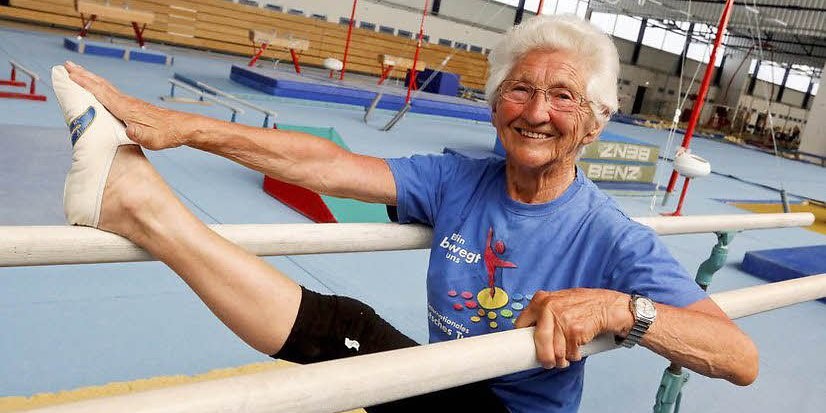
Johanna Quaas at 100: What the World’s Oldest Gymnast Can Teach Us About Strength, Health and Growing Older.
When 91-year-old Johanna Quaas appeared on Little Big Shots: Forever Young in 2017, host Steve Harvey and the audience were astonished. Then came an even more memorable moment: Olympic champion Simone Biles walked onto the stage.
After watching Quaas perform, Biles admitted she was “speechless” and described the German gymnast as an inspiration. Quaas had just demonstrated strength, flexibility and control on the parallel bars at an age when many people assume strenuous physical activity is no longer possible.
Nine years later, her story has become even more remarkable.
Johanna Quaas turned 100 on November 20, 2025. Recent reporting in 2026 continues to describe her at age 100, and she remains a striking example of what lifelong movement can contribute to healthy aging.
But there is something important about Quaas's story that is easily missed.
Her lesson is not that everybody should become a gymnast at 90.
It is that we should never voluntarily retire our bodies from movement simply because we are getting older.
A Lifetime Built Around Movement
Johanna Quaas was born in Hohenmölsen, Germany, on November 20, 1925. Her involvement with gymnastics began during childhood, but war and circumstances interrupted her early sporting ambitions. She later became a physical education teacher, coached gymnastics and was involved in sport for decades.
Remarkably, her competitive gymnastics career as an older adult developed much later in life. She became a successful senior gymnast and eventually attracted international attention for performing floor exercises and parallel-bar routines well into her 80s and 90s.
In 2012, at age 86, Guinness World Records certified her as the world's oldest active competitive gymnast.
She eventually stopped competitive apparatus gymnastics after an injury in 2018. That is another important part of her story: healthy aging does not mean refusing to accept physical changes. It means adapting to them.
Today, Quaas is no longer trying to reproduce the routines she performed at 86.
Instead, she continues to move.
At her 100th-birthday celebration, she told reporters that movement remained central to her life. She reportedly performs modified push-ups using her balcony railing each day because she wants to retain some of her muscle strength. Even the 16 stairs leading to her apartment provide regular activity.
That may be one of the most useful longevity lessons of all.
Your exercise at 80 does not have to look like your exercise at 40. It simply needs to continue.
Her Famous Morning “Bed Gymnastics”
Quaas has also promoted what has become known as her bed gymnastics routine.
Instead of jumping immediately out of bed, she performs gentle movements designed to mobilize the body. The exercises can involve stretching and controlled movements targeting areas including the trunk, back and legs.
A German medical-care organization that has worked with Quaas describes these exercises as a way older people can gently strengthen muscles and maintain or improve mobility, even when attending a gym or exercise class is difficult.
There is a powerful principle here.
Many people think exercise only counts when they put on sportswear and spend an hour in a gym.
Quaas's life suggests something different:
Movement can begin before your feet even touch the floor.
It can continue while walking upstairs, doing household chores, taking a walk, stretching, gardening or doing a few resistance exercises.
And modern health recommendations support this broader concept of movement. The World Health Organization emphasizes that physical activity can come from recreation, transportation, work and everyday activities—not merely formal exercise.
What Does Johanna Quaas Eat?
Whenever someone reaches 100 in unusually good physical condition, people naturally ask:
“What does she eat?”
There are many internet posts claiming extremely specific “Johanna Quaas diets.” Some describe detailed menus of fruits, lean meat, whole grains, particular supplements and other foods.
Those claims should be treated cautiously.
There is no well-documented public evidence that Quaas follows a complicated anti-aging diet or a particular branded dietary programme.
What she has consistently emphasized is much simpler:
Moderation.
At her 100th birthday, when asked whether movement alone explained her longevity, Quaas said that doing everything in moderation was important. She specifically indicated that this attitude applies even to things such as sweets and alcohol.
Previous accounts have also described her approach as eating a balanced diet, avoiding both overeating and undereating and including plenty of vegetables or greens.
So perhaps the more accurate description of her diet is not:
“Eat this miracle food and live to 100.”
It is:
Eat reasonably, eat a varied diet and avoid excess.
That approach is much closer to established healthy-aging recommendations.
The U.S. National Institute on Aging recommends that older adults emphasize nutrient-dense foods, including vegetables and fruits, whole grains and varied protein sources while limiting excess added sugars, saturated fats and sodium.
Quaas therefore offers us something much more useful than another fashionable diet.
She offers consistency without obsession.
Her Real Secret May Be Muscle
One detail from Quaas's 100th-birthday interview deserves special attention.
She said she continues her modified push-ups so that she can retain some of her muscles.
That statement is extremely significant.
As people age, maintaining muscle strength becomes increasingly important for everyday independence—getting out of a chair, climbing stairs, carrying groceries, recovering balance and protecting ourselves when we stumble.
This is why current physical-activity recommendations do not tell older adults simply to “walk.”
The CDC advises adults 65 and older to include three types of activity: aerobic exercise, muscle-strengthening activity and balance work.
The World Health Organization similarly recommends muscle-strengthening exercises on at least two days per week, along with activity that supports balance and coordination in older adulthood.
Johanna Quaas did not discover a magic anti-aging pill.
For decades, she repeatedly gave her muscles a reason to remain useful.
Balance Is a Longevity Skill Too
Watch Quaas's old gymnastics performances and one characteristic immediately stands out.
Her balance.
Gymnastics develops coordination, proprioception, flexibility and the ability to control your body through space.
We obviously do not need to copy her parallel-bar routines to obtain these benefits.
For older adults, something as simple as practising safe balance exercises can be valuable.
Falls can be life-changing in later life. That is why balance is specifically included in recommendations for older adults. The CDC notes that activities combining aerobic exercise, muscle strengthening and balance can improve physical function and reduce the risk of falls or fall-related injury.
The lesson is therefore not:
Learn gymnastics at 80.
The lesson is:
Do not neglect the physical abilities that keep you independent.
Strength matters.
Balance matters.
Mobility matters.
Flexibility matters.
And they need to be practised.
Perhaps Her Greatest Secret Is Consistency
There is an enormous difference between exercising occasionally and building movement into one's identity.
Johanna Quaas has spent much of her life moving.
That means she did not suddenly reach 80 and decide to repair decades of inactivity with a 30-day exercise challenge.
Movement became normal.
That may explain why her simple morning mobility routine is so interesting.
Five or ten minutes may appear insignificant.
But repeated every morning for years, small behaviours accumulate.
This is one of the most practical health lessons her story offers:
Do something your body can tolerate—and keep doing it.
Healthy aging is rarely built through dramatic actions performed occasionally.
It is more often built through ordinary actions repeated for decades.
She Also Knows When to Adapt
There is another side of Quaas's story that deserves attention.
She is not invincible.
She has experienced injuries and age-related physical changes. After a torn biceps tendon in 2018, she stopped competitive apparatus gymnastics.
At 100, she has also acknowledged that some aspects of everyday life have become more difficult, and reports from her centenary noted some decline in memory. Her daughters help care for her.
This makes her story more—not less—valuable.
Healthy aging does not mean never becoming frail, never developing illness, never needing help or possessing the same body at 100 that you had at 30.
Aging still happens.
The goal is to preserve as much function, independence and quality of life as possible for as long as possible.
Quaas adapted from competitive gymnastics to gentler movement.
That is wisdom.





Comments