

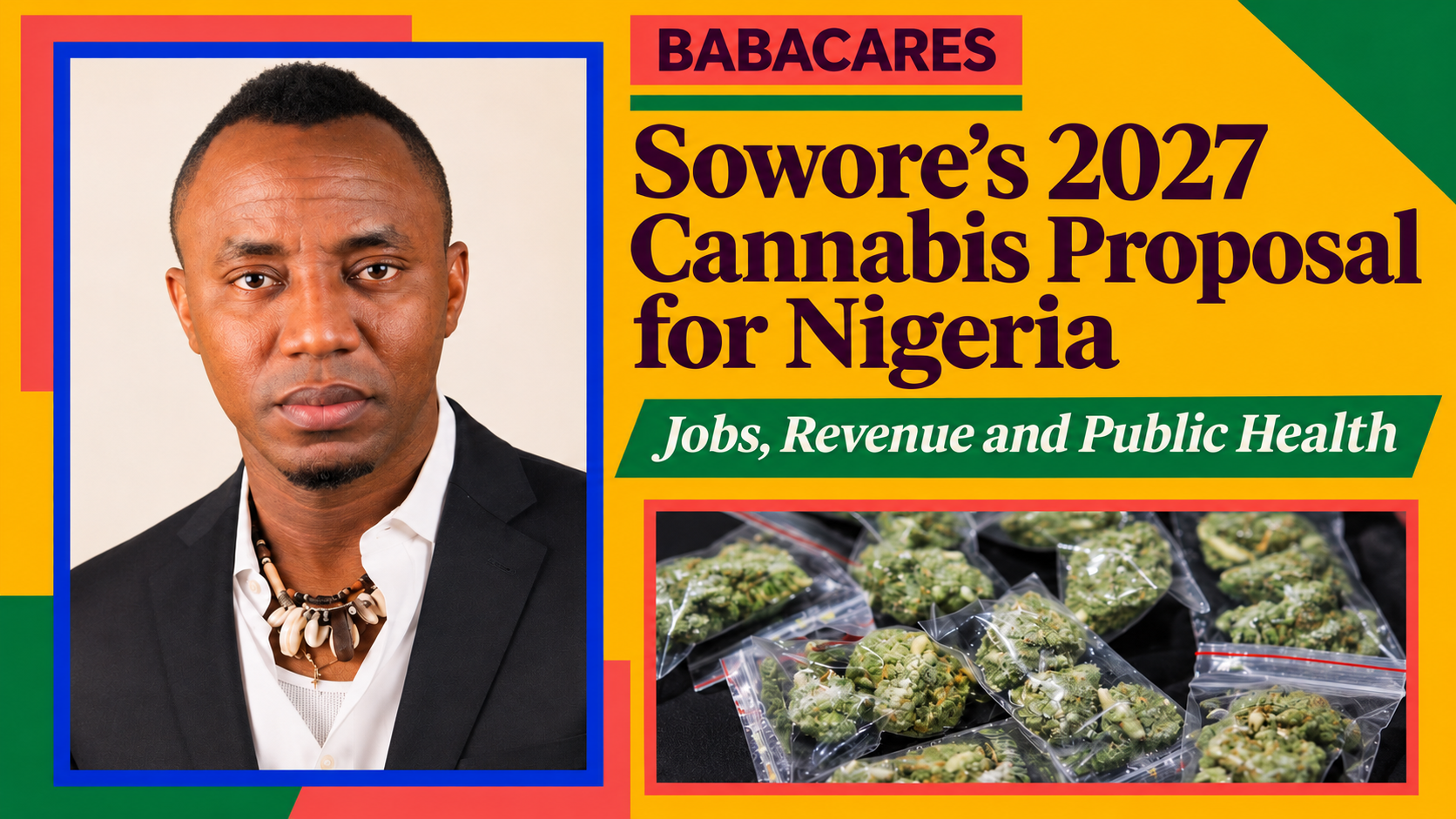
Sowore’s 2027 Cannabis Proposal for Nigeria: Jobs, Revenue and the Health Risks
By Babajide Moronfolu | Babacares | November 21, 2026
Could legalising cannabis create jobs for Nigerian farmers and bring in billions of naira in public revenue? Omoyele Sowore has put that question on the agenda for Nigeria’s 2027 presidential election. In a November 17 post tagged #Sowore2027, the African Action Congress candidate called for a regulated cannabis industry that he says could create jobs, support farmers and generate tax revenue. He also pointed to potential opportunities in pharmaceutical manufacturing, industrial hemp and research. www.teapaw.org
Could cannabis become legal if Sowore wins in 2027?
Sowore’s November 17 post links his call for legalisation to his presidential campaign. The post gives no specific date for the policy to take effect. If elected, he could ask the National Assembly to change Nigeria’s cannabis laws. Under Section 58 of the Constitution, federal legislation generally requires passage by both the Senate and the House of Representatives and presidential assent. Nigeria’s Indian Hemp Act currently prohibits cannabis cultivation and penalises unlawful possession and sale. www.teapaw.org
The scope of any bill would matter. Allowing prescription cannabis medicines, licensing industrial hemp for products such as fibre, and opening recreational sales to adults would each create different markets and require different safeguards. Other countries offer examples of how those choices can play out. www.euda.europa.eu
Where is cannabis legal around the world?
| Approach | Examples |
|---|---|
| Nationwide regulated adult access | Canada allows legal adult retail sales under federal, provincial and territorial rules. Uruguay regulates access through participating pharmacies, registered home cultivation and membership clubs. gazette.gc.ca |
| Adult use under state or territorial law | In the United States, a tally from the National Conference of State Legislatures found that 24 states, three territories and Washington, D.C. allowed or regulated adult use as of June 2025. Rules vary by jurisdiction, and federal restrictions still apply. ncsl-www-d7akbtbzeqfvaces.westus2-01.azurewebsites.net |
| Limited private use or home cultivation | Germany, Malta, Luxembourg and Czechia permit limited home cultivation under different rules. Germany and Malta also allow regulated nonprofit associations to supply members. South Africa protects private adult use and cultivation for personal consumption. Mexico has a permit pathway for personal adult use following a Supreme Court ruling. www.euda.europa.eu |
| Pilot programmes and tolerated sales | The Netherlands tolerates qualifying coffeeshop sales and is testing a regulated supply chain in selected municipalities. Switzerland has run limited trials of legal adult sales. www.euda.europa.eu |
| Medical access under separate rules | Several European countries permit certain cannabis-based medicines or preparations. Thailand tightened its rules in 2025 and requires a prescription for cannabis flower. www.euda.europa.eu |
What are the health benefits and risks?
Evidence for medical use is strongest for specific products used to treat specific conditions. The U.S. Food and Drug Administration has approved purified cannabidiol, or CBD, for seizures associated with certain rare disorders. It has also approved certain cannabinoid medicines for chemotherapy-related nausea and vomiting. A 2025 evidence review found that some cannabis products may offer small, short-term relief for some people with chronic nerve pain. Longer-term benefits remain uncertain. www.fda.gov
Cannabis can impair driving, lead to dependence and trigger anxiety or paranoia. Research links cannabis use to a higher risk of psychosis, with a stronger association among people who start young or use frequently. Edible products can also poison children who mistake them for sweets. Ontario’s public health guidance advises avoiding cannabis during pregnancy and breastfeeding. www.ontario.ca
Could Nigeria really earn ₦2.86 trillion a year?
₦2.86 trillion was the highest of three hypothetical annual revenue scenarios Sowore presented. He arrived at the figure by converting an assumed US$2.2 billion at an illustrative exchange rate. Actual receipts would depend on how much consumers buy through legal channels, how the government taxes and licenses businesses, and how effectively it enforces the rules. www.thecable.ng
Canada provides a real-world comparison. Statistics Canada reported C$5.5 billion in legal cannabis sales and C$2.5 billion in government revenue in the 2024–25 fiscal year. Sales and government revenue measure different things. A Nigerian estimate would also need to account for public spending on regulation, enforcement, prevention and treatment. Canada’s expert panel found that legal sellers displaced part of the illicit market, which continued to operate. www.statcan.gc.ca
A regulated Nigerian industry could create jobs in farming, processing, testing and distribution. Who benefits would depend partly on whether small farmers can afford licences, meet testing requirements and obtain financing. The public health costs would also depend on the rules Nigeria sets for advertising, packaging, sales to adults and impaired driving, as well as the support available to people who develop problems with cannabis use. www.thecable.ng
As the 2027 campaign unfolds, the questions for Sowore are concrete. What exactly would his administration seek to legalise? How would small farmers get a fair chance to participate? And what would it cost to regulate the market and protect public health? Those answers would give voters a better basis for judging the proposal and its revenue claims.
Read more on Babacares.com, subscribe and share.
https://www.babacares.com.131-153-147-50.cpanel.site/blog-details?details=1200&title=Sowore%E2%80%99s+2027+Cannabis+Proposal+for+Nigeria%3A+Jobs%2C+Revenue+and+the+Health+Risks






Comments