

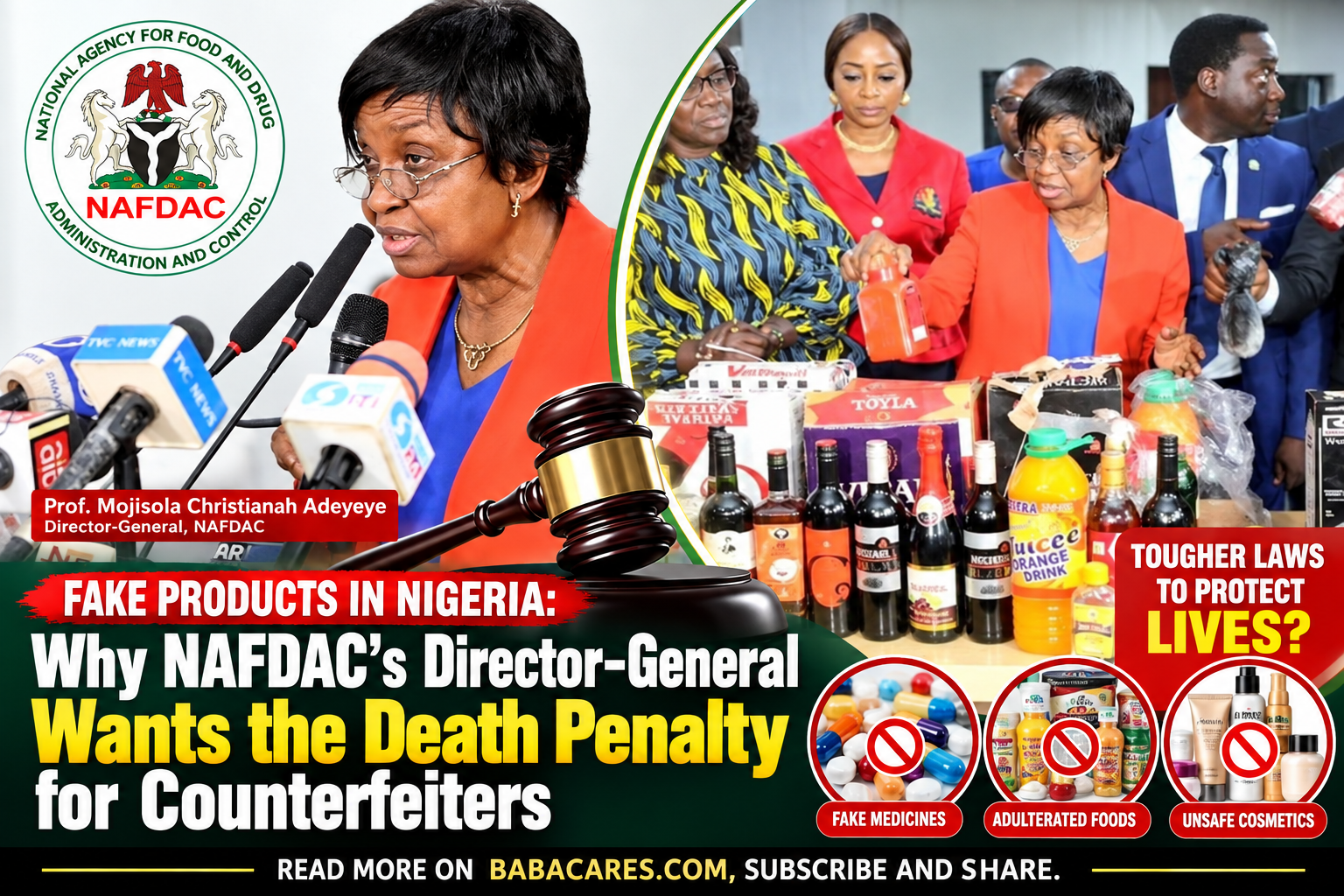
Fake Products in Nigeria: Why Director-General Of NAFDAC Wants the Death Penalty for Counterfeiters.
Should someone who knowingly manufactures or distributes counterfeit products capable of killing innocent consumers face the death penalty?
That is the difficult question raised by the Director-General of Nigeria's National Agency for Food and Drug Administration and Control (NAFDAC), Professor Mojisola Christianah Adeyeye.
As concerns grow over fake medicines, adulterated foods, counterfeit toothpaste, unsafe packaged water and other substandard consumer products, Adeyeye is calling for tougher punishments, including life imprisonment and the death penalty for those convicted of serious counterfeiting offences.
Her proposal has brought renewed attention to a disturbing public-health problem: products purchased by unsuspecting consumers may be ineffective, contaminated or dangerous.
Why the NAFDAC boss wants tougher penalties
In February 2025, Adeyeye publicly advocated capital punishment for counterfeit drug offenders, particularly where their actions result in children's deaths.
Speaking on Channels Television, she cited a case in which laboratory testing reportedly found that a medicine marketed for children contained none of the expected active ingredient.
She questioned whether existing fines and prison sentences were sufficient to discourage criminals who profit from selling dangerous medicines.
In September 2026, she renewed her call, extending the discussion to the manufacture and distribution of fake regulated products more broadly.
Adeyeye wants the National Assembly to strengthen relevant legislation, arguing that counterfeiting is not merely an economic crime but a serious threat to human life.
Channels Television
+2
What NAFDAC's latest enforcement figures reveal
According to figures presented by NAFDAC in September 2026:
-
The agency removed 7,210 products during nationwide post-marketing surveillance between May and July 2026.
-
It reported 64 convictions of counterfeiters between June 2025 and June 2026.
-
Convicted offenders reportedly received prison sentences ranging from one to seven years.
-
Investigations have involved suspected counterfeit packaged water, toothpaste and other regulated consumer products.
These are agency-reported enforcement figures, not evidence that all the products involved caused injury or death. Nevertheless, they illustrate the extent of regulatory activity required to address the problem.
THISDAYLIVE
+1
The public-health consequences of fake products
The dangers go beyond financial losses to legitimate manufacturers.
Counterfeit or substandard medicines may contain the wrong ingredients, insufficient active substances, harmful contaminants or inappropriate doses. They can cause treatment failure, poisoning and, in severe cases, death.
Adulterated food and drinking water may expose consumers to harmful microorganisms, chemicals or contaminants, potentially causing diarrhoeal diseases, poisoning and other health complications.
Fake cosmetics and personal-care products may contain unsafe ingredients or fail quality standards, presenting risks of skin irritation, burns, allergic reactions and other injuries.
Importantly, not every unregistered, substandard or incorrectly labelled product presents the same level of danger. Regulators must distinguish deliberate criminal counterfeiting from manufacturing errors and other regulatory violations.
Is the death penalty already part of Nigerian law?
No. The death penalty advocated by Professor Adeyeye remains a proposed legislative change, not an existing general punishment for counterfeit-product offences.
Nigeria's Counterfeit and Fake Drugs and Unwholesome Processed Foods legislation already provides penalties for certain offences, including fines and imprisonment.
Adeyeye wants lawmakers to introduce substantially stronger sanctions through legislative amendments.
Any such change would require proper legislative and constitutional processes, with offences and penalties clearly defined.
NAFDAC
+1
But will the death penalty stop counterfeiting?
This is where the debate becomes more complicated.
Supporters of harsher punishment argue that criminals who knowingly endanger lives should face consequences proportionate to the harm they cause.
However, human-rights organizations, including Amnesty International, maintain that there is no convincing evidence that capital punishment deters crime more effectively than imprisonment. They also highlight the irreversible consequences of wrongful convictions.
Amnesty International
For Nigeria, the important questions include whether tougher laws would increase convictions, whether enforcement agencies have adequate resources, and how the justice system would distinguish deliberate counterfeiting from other regulatory offences.
What should Nigeria do beyond harsher punishment?
A comprehensive response should combine strong legal accountability with prevention and consumer protection.
NAFDAC needs adequately equipped laboratories, effective border surveillance, routine market inspections and timely public warnings. Manufacturers and distributors should be subject to traceability requirements, while consumers must have accessible channels for reporting suspicious products.
The World Health Organization recommends an approach built around preventing, detecting and responding to substandard and falsified medical products.
World Health Organization
Public education is equally important. Consumers should be encouraged to buy medicines from licensed outlets, examine packaging carefully, check applicable product registrations and report suspicious products rather than relying on appearance alone.
Babacares perspective: Protecting lives must remain the priority
The call by Professor Adeyeye reflects legitimate concerns about the dangers of counterfeit products and the difficulty of holding offenders accountable.
Yet the debate should go beyond whether counterfeiters deserve the death penalty.
The greater public-health challenge is ensuring that dangerous products never reach consumers in the first place.
Nigeria must strengthen regulatory institutions, improve product testing, ensure fair and effective prosecution, and address weaknesses that allow counterfeit supply chains to flourish.
Ultimately, the success of any reform should be measured not simply by the severity of punishment but by reductions in counterfeit products, preventable illness and consumer deaths.
What do you think? Should Nigeria introduce the death penalty for deliberate counterfeit-product offences that result in death, or would life imprisonment and stronger enforcement provide a better solution?
READ MORE ON BABACARES.COM, SUBSCRIBE AND SHARE.
References
-
Channels Television — NAFDAC Seeks Death Penalty for Drug Peddlers, February 7, 2025
-
News Agency of Nigeria — NAFDAC DG Calls for Death Penalty for Drug Crimes, February 26, 2025
-
THISDAY — NAFDAC Seeks Life Imprisonment, Death Penalty for Fake Product Dealers, September 9, 2026
-
World Health Organization — Substandard and Falsified Medical Products
-
Amnesty International — Evidence on the Death Penalty and Deterrence










Comments