

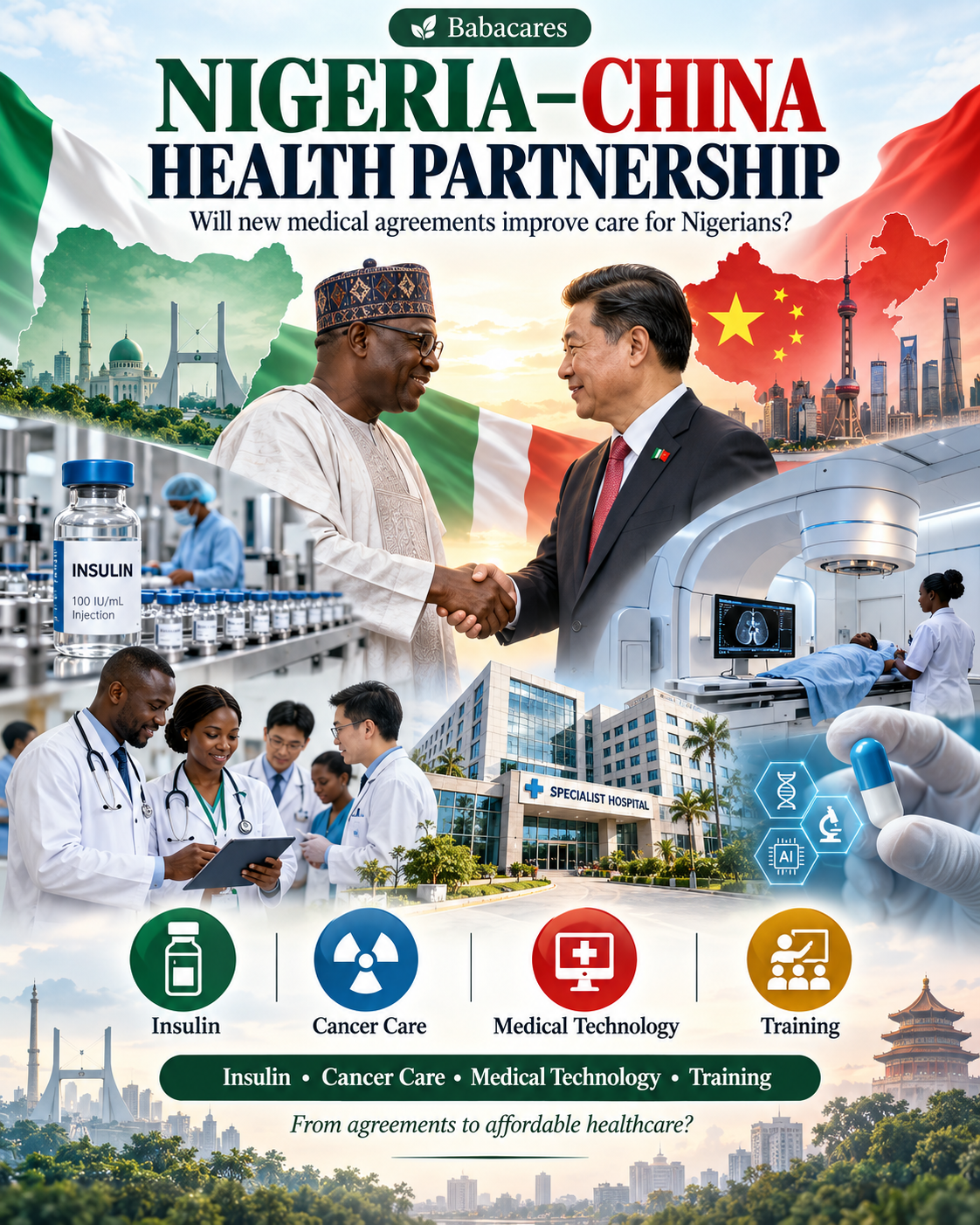
NIGERIA–CHINA HEALTH PARTNERSHIP: WILL NEW MEDICAL AGREEMENTS BRING AFFORDABLE HEALTHCARE TO NIGERIANS?
From insulin production and cancer treatment to medical technology and hospital development, Nigeria is expanding healthcare cooperation with China. But will ordinary Nigerians feel the benefits?
By Babajide Moronfolu | Babacares
For millions of Nigerians, the greatest healthcare challenge is not necessarily the absence of medical knowledge. It is the difficulty of accessing affordable, timely, and quality treatment.
Across the country, families struggle with the cost of medicines, cancer treatment, diagnostic examinations, and specialised medical care.
Some patients travel abroad for treatment, while others are forced to delay care because they cannot afford it.
Against this background, Nigeria's expanding healthcare partnership with China offers opportunities worth examining.
A Channels Television report published on September 11, 2025, highlighted an agreement between Nigeria's National Biotechnology Research and Development Agency (NBRDA) and China's Shanghai Haiqi Industrial Company Limited to establish an insulin manufacturing facility in Nigeria.
Since then, additional cooperation announced in 2026 has focused on cancer treatment, medical technology, training, and healthcare delivery.
But agreements alone do not save lives. Effective implementation does.
1. Insulin Production: Hope for Nigerians Living With Diabetes
One important development is the agreement to establish a domestic insulin production facility.
Insulin is an essential medicine for people with type 1 diabetes and some people with type 2 diabetes.
When insulin becomes unaffordable or unavailable, patients can experience dangerously high blood sugar levels and potentially life-threatening complications.
According to Channels Television, the proposed Nigeria–China insulin project aims to reduce dependence on imported products and strengthen domestic pharmaceutical production.
If successfully implemented, local manufacturing could improve medicine security, create jobs, and potentially reduce supply costs.
However, the agreement does not automatically guarantee cheaper insulin.
Actual affordability will depend on production costs, regulatory approval, distribution, pricing, and access through Nigeria's healthcare system.
2. Cancer Treatment: Expanding Radiotherapy Capacity
Another significant development came in August 2026, when Nigeria announced cooperation with Chinese partners to strengthen cancer treatment and radiotherapy services.
The initiative includes technical assistance, professional training, research collaboration, and cooperation with Chinese medical technology company LinaTech.
Minister of State for Health and Social Welfare, Dr Iziaq Adekunle Salako, emphasized the importance of developing the skilled workforce needed to operate sophisticated equipment.
This is particularly relevant because Nigeria needs more accessible cancer diagnosis and treatment services.
The government has also outlined ambitions for local assembly and maintenance of radiotherapy technology.
But signing a cooperation agreement is not the same as installing functioning machines in hospitals.
The public needs clear information about project timelines, locations, funding, maintenance, and patient access.
3. China's Floating Hospital: A New Medical Outreach Planned for Lagos
In a development announced on October 20, 2026, Nigeria's Federal Ministry of Health welcomed a proposed medical mission involving the Chinese Navy hospital ship Ark of Peace.
The outreach is scheduled for November 10–17, 2026, in Lagos.
According to the ministry, the floating hospital is expected to provide medical consultations, diagnostic services, selected surgical procedures, and cataract-related treatment.
The proposed programme also includes community outreach and professional exchanges between Nigerian and Chinese healthcare workers.
This could offer valuable short-term medical assistance to selected patients.
However, the mission has not yet taken place, and its actual patient numbers and outcomes cannot be assessed in advance.
A temporary medical mission, no matter how beneficial, cannot replace a strong, accessible, and adequately funded national healthcare system.
4. What About Nigerian Healthcare Workers?
International partnerships should not focus only on importing equipment.
Nigeria also needs sustained investment in doctors, nurses, pharmacists, laboratory scientists, biomedical engineers, and community healthcare personnel.
Training, technology transfer, equipment maintenance, and professional development must be central to the cooperation.
If Nigerian healthcare professionals receive specialised training and institutional support, the long-term benefits could extend beyond individual hospitals.
But workforce retention also matters.
Newly trained professionals need safe working environments, reasonable remuneration, and functioning facilities where they can use their skills.
5. Could This Reduce Medical Tourism?
Nigeria's dependence on overseas medical care for certain specialised treatments has long raised concerns.
Improving domestic cancer treatment, diagnostics, pharmaceutical production, and hospital infrastructure could reduce some reasons patients seek care abroad.
But medical tourism will not decline simply because new agreements are announced.
Patients need confidence in the quality, affordability, safety, and reliability of healthcare services at home.
For medical tourism to decrease sustainably, Nigeria must strengthen its healthcare system and earn public trust.
THE BABACARES PERSPECTIVE: FIVE QUESTIONS GOVERNMENT MUST ANSWER
The Nigeria–China partnership deserves careful attention, but the public should demand measurable results.
First, when will the proposed projects become operational?
Second, how much will ordinary patients pay for the services?
Third, which Nigerian hospitals and communities will benefit?
Fourth, what safeguards will ensure equipment quality, medicine safety, and professional accountability?
Finally, how will government measure and publicly report the partnership's impact?
These questions are essential because healthcare development should not be judged by the number of memoranda signed, but by actual improvements in patient care.
FINAL THOUGHTS: FROM AGREEMENTS TO ACCESSIBLE HEALTHCARE
Nigeria's cooperation with China offers potential opportunities to strengthen its health sector through local manufacturing, medical technology, professional training, and specialised treatment.
These initiatives should be welcomed as opportunities for progress, while being subjected to transparent monitoring and public accountability.
At Babacares, we believe healthcare partnerships succeed when patients can access treatment earlier, obtain essential medicines reliably, and receive quality care without catastrophic financial hardship.
Nigeria does not simply need more healthcare agreements. It needs agreements that translate into functioning hospitals, affordable medicines, competent healthcare professionals, and healthier citizens.
That is the standard by which this partnership should ultimately be judged.
READ MORE ON BABACARES.COM, SUBSCRIBE AND SHARE.
References
-
Channels Television — Nigeria Signs Insulin Plant Deal With China's Shanghai Haiqi, September 11, 2025.
-
Federal Ministry of Information and National Orientation — FG Strengthens China Partnership to Expand Cancer Care, Radiotherapy Capacity in Nigeria, August 15, 2026.
-
Federal Ministry of Information and National Orientation — Nigeria, China Deepen Health Partnership on Medical Technology, AI, Local Manufacturing, August 14, 2026.
-
Federal Ministry of Information and National Orientation — FG Welcomes Chinese Navy Hospital Ship's Medical Outreach, October 20, 2026.
-
Federal Ministry of Health and Social Welfare — Nigeria–China bilateral cooperation in traditional medicine research, June 2026.











Comments