

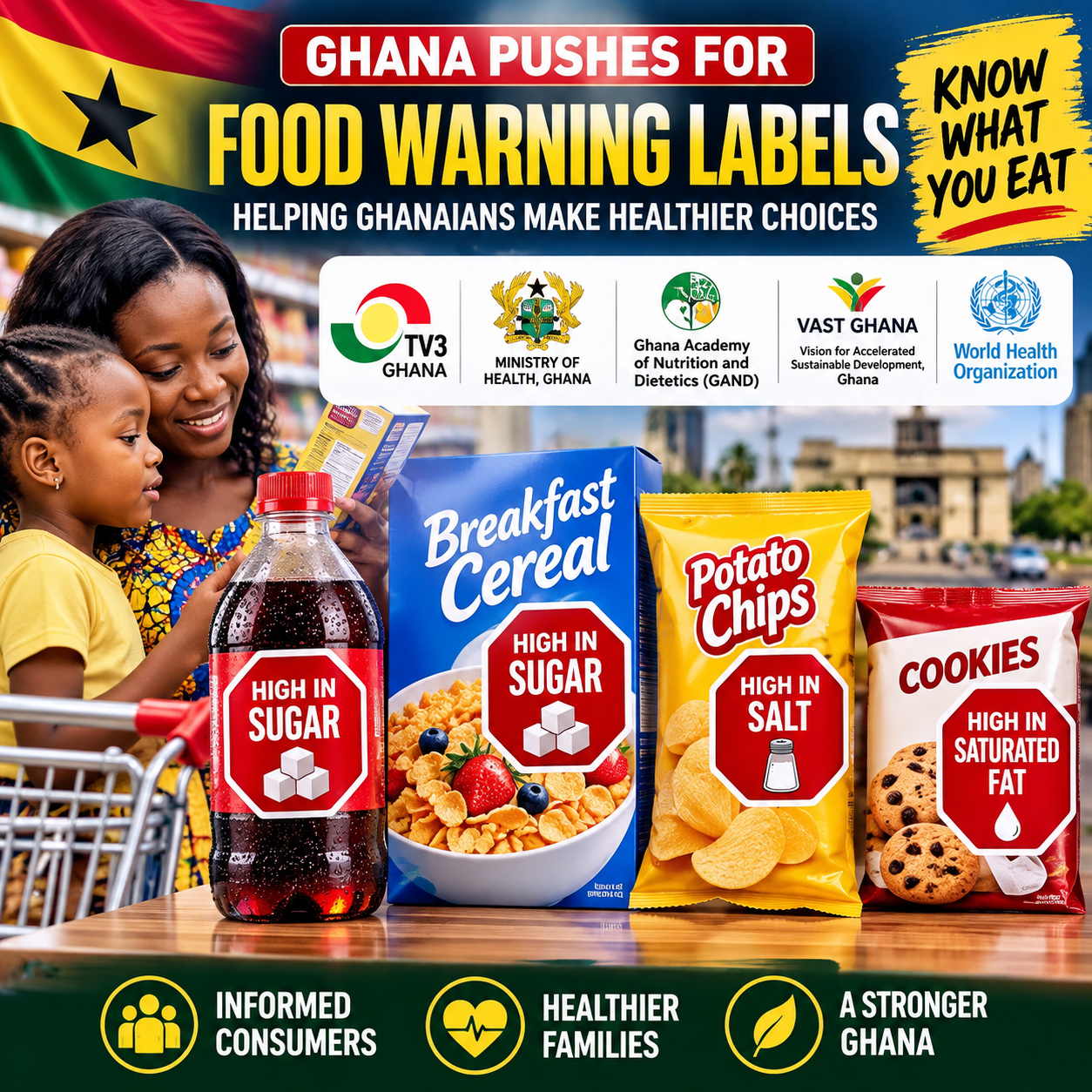
KNOW WHAT YOU EAT: GHANA PUSHES FOR FOOD WARNING LABELS AS DIABETES, HYPERTENSION AND HEART DISEASE RAISE CONCERN.
Could the food sitting on your supermarket shelf be quietly increasing your risk of serious illness? Ghana's campaign for clearer food warning labels is raising an important question for the whole of Africa: Do consumers really know what they are eating?
By Babajide Moronfolu | Babacares Health & Wellness
October 14, 2026
Imagine walking into a supermarket to buy breakfast cereal for your children, a bottle of fruit drink or a packet of biscuits. The packaging looks attractive, the advertisements promise goodness, and everything appears perfectly healthy.
But hidden behind the colourful packaging could be something you rarely consider: excessive amounts of sugar, salt or saturated fat.
For millions of consumers, understanding the nutritional information printed in tiny letters on the back of food packages can be difficult.
Now, Ghanaian health advocates want to change that.
A growing campaign for Front-of-Pack Warning Labels (FOPWL) is calling for simple, prominent warnings on packaged foods that exceed established nutritional thresholds.
The message is straightforward:
KNOW WHAT YOU EAT BEFORE IT AFFECTS YOUR HEALTH.
Ghana's Growing Campaign for Food Transparency
In September 2026, Ghanaian public-health organisations intensified efforts to promote clearer food labelling.
The campaign involves organisations including SEND Ghana, the Ghana Academy of Nutrition and Dietetics (GAND), and Vision for Accelerated Sustainable Development (VAST Ghana), with support from the Ministry of Health and Ghana's Food and Drugs Authority.
Media organisations, including TV3 Ghana, have also helped bring public attention to the issue.
The campaign aims to help consumers identify packaged foods containing excessive levels of nutrients linked to diet-related diseases.
It is important to clarify that Ghana is still advancing the development and adoption of its mandatory warning-label policy. Public advocacy should not be confused with a nationwide requirement already in force.
Nevertheless, the campaign represents an important public-health conversation.
What Exactly Are Front-of-Pack Warning Labels?
Front-of-Pack Warning Labels are simple symbols or messages placed prominently on food packaging.
Instead of expecting consumers to study complicated nutritional tables, warning labels can immediately draw attention to certain ingredients or nutrients.
Depending on the country's regulations, they may indicate:
-
HIGH IN SUGAR
-
HIGH IN SALT OR SODIUM
-
HIGH IN SATURATED FAT
For example, a sugary drink might carry a warning that it contains excessive sugar.
A packaged snack could display a warning about high sodium content.
These warnings do not necessarily mean that eating the product once will cause illness. They help consumers understand nutritional risks, particularly when such products are consumed frequently or in large quantities.
The objective is informed choice, not fear.
Why This Matters for African Families
Across Africa, changing lifestyles and food environments are influencing dietary habits.
Traditional meals increasingly compete with highly marketed packaged snacks, sweetened beverages and convenient ready-to-eat foods.
Some of these products contain significant amounts of added sugar, salt or saturated fat.
Excessive and frequent consumption can contribute to health problems over time.
1. Diabetes
Regular consumption of sugary drinks can contribute to weight gain and increase the risk of developing type 2 diabetes.
Diabetes can also lead to serious complications involving the eyes, kidneys, nerves and cardiovascular system.
2. High Blood Pressure
Excessive sodium consumption is associated with increased blood pressure.
Hypertension is a major risk factor for stroke, heart disease and kidney problems.
3. Obesity
Frequent consumption of energy-dense foods and sugary beverages can contribute to excessive calorie intake and weight gain.
Obesity increases the risk of several chronic health conditions.
4. Heart Disease
Diets high in saturated fat can raise LDL cholesterol in many people, increasing cardiovascular risk, particularly when saturated fat replaces healthier unsaturated fats.
These diseases have multiple causes, including genetics, physical activity and overall dietary patterns. Food warning labels are intended to address one important part of prevention.
Why Children Need Special Protection
One of my greatest concerns is the influence of food marketing on children.
Colourful packaging, cartoon characters and exciting advertising can make sugary cereals, snacks and beverages appear especially attractive.
Children often make food choices based on appearance and taste rather than nutritional value.
Parents, meanwhile, may be managing limited budgets and busy schedules.
Clear labels could make it easier for families to identify products high in sugar, sodium or saturated fat without spending several minutes interpreting complex nutritional information.
But warning labels alone will not solve childhood obesity or unhealthy eating habits.
Nutrition education, affordable healthy foods and responsible marketing practices are equally important.
What Ghana Can Learn From Canada
Here in Canada, front-of-package nutrition labelling has already become part of the country's food regulatory system.
Beginning January 1, 2026, most prepackaged products meeting specified thresholds for saturated fat, sugars or sodium must display a standardised front-of-package nutrition symbol, subject to exemptions.
The Canadian system uses a black-and-white symbol to identify nutrients present in high amounts.
This gives shoppers a quicker way to compare products.
Canada's experience demonstrates how governments can establish a consistent national labelling framework.
However, labels are not a substitute for understanding the overall nutritional quality of food. A product without a warning symbol is not automatically healthy.
What About Nigeria?
As a Nigerian journalist and healthcare communicator, I believe this discussion deserves serious attention beyond Ghana.
Walk into many supermarkets and neighbourhood shops across Nigeria, and you will find an enormous range of soft drinks, biscuits, instant noodles, breakfast cereals and other packaged foods.
How many consumers carefully examine their nutritional content?
How many parents understand the difference between naturally occurring sugars and added sugars?
How many people know how much sodium they consume daily?
Food manufacturers should provide accurate and understandable nutritional information.
At the same time, consumers need practical education to interpret that information.
Nigeria and other African countries can learn from international experience while developing policies suitable for their own food environments.
Should Food Manufacturers Be Worried?
Some manufacturers may have concerns about implementation costs, packaging changes and how consumers interpret warning symbols.
Those concerns deserve consideration during policy development.
However, consumer protection and commercial interests do not have to be mutually exclusive.
Clear nutrition labelling may encourage manufacturers to reformulate products by reducing sugar, sodium or saturated fat.
It can also support fairer competition by making nutritional differences easier to identify.
The ultimate objective should be healthier products and better-informed consumers.
My Final Thoughts: Prevention Begins With Information
One lesson I have learned through my years in healthcare is that many chronic diseases develop gradually.
High blood pressure may remain unnoticed for years.
Type 2 diabetes can develop without obvious early symptoms.
Poor dietary habits may become established long before their consequences are recognised.
This is why prevention matters.
Ghana's campaign for Front-of-Pack Warning Labels deserves attention, not because warning labels will eliminate disease, but because they could help people make better-informed everyday decisions.
Consumers should not need a degree in nutrition to understand what is inside the food they buy.
Food packaging should provide useful information, not simply attractive marketing.
And protecting public health should begin long before a patient enters a hospital.
A healthier Africa begins with informed choices — and sometimes, those choices begin with a simple warning on a food package.
A Question for Our Readers
When shopping for food, do you read the nutritional information, or do you rely mainly on the brand, packaging and price?
Would you support clear warning labels on packaged foods containing excessive sugar, salt or saturated fat?
Share your thoughts.
Babajide Moronfolu
Babacares — Promoting Healthy Living, Consumer Awareness and Better Choices.










Comments