

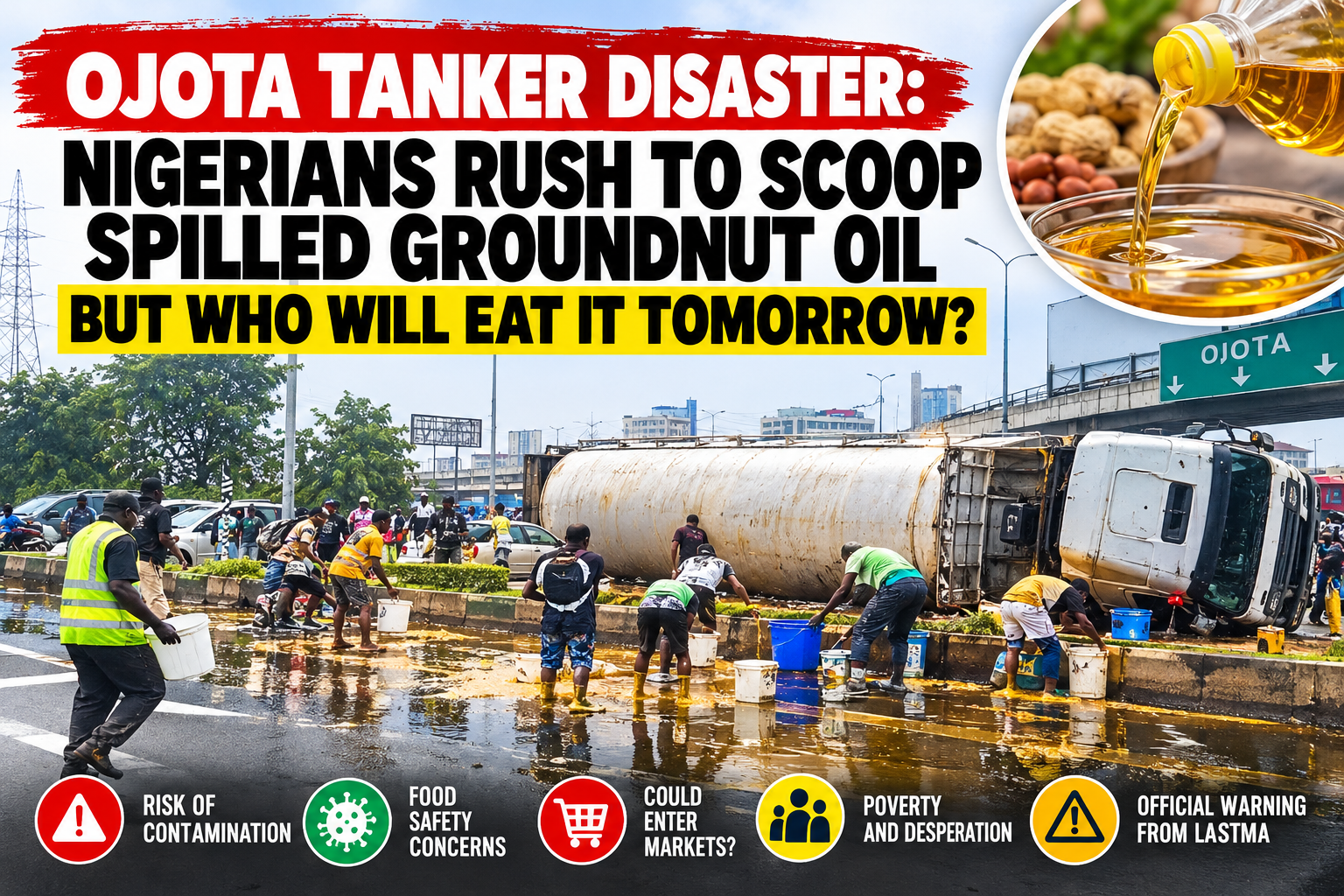
OJOTA TANKER DISASTER: NIGERIANS RUSH TO SCOOP SPILLED GROUNDNUT OIL — BUT WHO WILL EAT IT TOMORROW?
A tanker overturns, residents rush for free cooking oil, and a disturbing public-health question emerges: Could contaminated oil eventually find its way into Nigerian kitchens?
By Babajide Moronfolu | Babacares Health & Wellness
October 14, 2026
What if the groundnut oil used to prepare your family's next meal came from a dirty Lagos roadway, where a tanker had overturned hours earlier?
What if that oil had mixed with road dust, drainage water, vehicle residues and other contaminants before being collected, repackaged and possibly sold to unsuspecting consumers?
And what if the people who eventually bought it never knew where it came from?
These are the troubling questions arising from a tanker accident in Lagos on Wednesday, October 14, 2026.
A tanker carrying approximately 33,000 litres of groundnut oil overturned near Ojota Bridge, around Abiola Garden, on the inward approach towards the Old Toll Gate.
The incident reportedly caused severe traffic disruption, but what followed attracted even greater public concern.
Instead of keeping away from the accident scene, some residents reportedly rushed towards the spilled cooking oil with buckets, bowls, jerrycans and other containers.
Videos circulated across social media showing people scooping oil from the accident scene.
To some observers, it was another example of Nigerians making the most of an unexpected opportunity.
To others, including this writer, it was a deeply disturbing reminder of how economic hardship, dangerous public behaviour and food-safety concerns can intersect.
But the biggest question remains: Where will all that recovered oil eventually end up?
LASTMA Sounds the Alarm
The Lagos State Traffic Management Authority (LASTMA) has warned residents, traders and food vendors against consuming or selling groundnut oil recovered from the accident scene.
According to reports quoting the agency, preliminary security findings suggested that suspected brake failure caused the tanker to overturn.
LASTMA General Manager, Olalekan Bakare-Oki, expressed concern that individuals were collecting oil from the road and drainage channels, warning that it might have become contaminated.
The agency deployed emergency and traffic management personnel to assist with the recovery operation and restore movement along the affected corridor.
Fortunately, reports indicated that no casualties were recorded.
However, preventing injuries at the accident scene is only one part of the public-health challenge.
The Hidden Health Dangers of Spilled Cooking Oil
Groundnut oil is widely used in Nigerian homes, restaurants and roadside food businesses.
Under properly controlled production, transportation and storage conditions, it is a familiar cooking ingredient.
But when edible oil spills onto a public road, its safety can no longer be assumed.
The oil may come into contact with several potentially harmful substances.
1. Chemical contamination
Road surfaces may contain traces of engine oil, fuel residues, grease, tyre particles and other environmental pollutants.
If these substances mix with cooking oil, they can introduce chemical hazards that may not be visible to the naked eye.
2. Bacterial and environmental contamination
Oil collected from drainage channels, roadside puddles or contaminated containers may carry water, dirt and disease-causing microorganisms.
Although bacteria do not generally grow well in pure, dry oil, contamination with water and food residues can introduce additional food-safety risks.
3. Physical contamination
Sand, glass fragments, metal particles, rubber debris and other materials from the accident scene could enter the spilled oil.
These foreign materials may make the recovered oil unsuitable for food preparation.
4. Danger from attempted purification
Some people may assume that filtering dirty oil through a cloth or heating it sufficiently will make it safe.
Unfortunately, this is not a reliable solution.
Filtering may remove visible particles, and heating may destroy some microorganisms, but neither process can be trusted to eliminate all possible chemical contaminants.
Oil recovered from a contaminated roadway should not be considered safe for human consumption.
Could the Oil Find Its Way Into Nigerian Markets?
This is perhaps the most worrying question.
There is currently no verified evidence presented here that the groundnut oil collected at Ojota has already been repackaged or sold to the public.
Nevertheless, the possibility deserves serious attention.
Nigeria has a large informal food economy involving open markets, roadside food sellers, small restaurants and independent cooking-oil retailers.
In markets where consumers sometimes purchase unlabelled cooking oil from open containers, tracing a product's origin can be difficult.
The danger is not simply that someone might take the recovered oil home.
The wider concern is that potentially contaminated oil could be mixed with other products or resold to consumers who have no knowledge of its history.
For this reason, authorities should consider targeted surveillance and public education to prevent any unsafe recovered oil from entering the food supply.
Poverty, Desperation and the Price of Survival
There is another side to this story that deserves careful consideration.
Nigeria's difficult economic environment has placed immense pressure on many households.
Food inflation, high transportation costs, unemployment and reduced purchasing power have made everyday essentials increasingly expensive for numerous families.
For a household struggling to afford cooking oil, the sight of large quantities flowing freely onto a road might appear to represent an unexpected opportunity.
But desperation should never become a death sentence.
We must ask ourselves why some people would expose themselves to danger to collect food that has already been spilled onto a public roadway.
Is it ignorance of the health implications?
Is it a reflection of deepening poverty?
Or have repeated economic difficulties gradually normalised the acceptance of avoidable risks?
The answers may involve all these factors, although the motivations of the specific individuals in the video cannot be established from the footage alone.
Rather than simply mocking those involved, we should confront the social and economic conditions that make such behaviour possible.
At the same time, economic hardship cannot make contaminated food safe.
A Message to Nigerian Families and Food Vendors
At Babacares, our concern is not limited to the people seen collecting the oil.
It extends to ordinary Nigerians who may unknowingly purchase cooking oil from questionable sources.
Consumers should be particularly careful when buying unlabelled or unusually cheap cooking oil whose origin cannot be established.
Food vendors also have a responsibility to ensure that their ingredients come from reliable suppliers.
The consequences of unsafe food can be especially serious for children, older adults, pregnant women and people with weakened immune systems.
Consumers should remember that the appearance, colour or smell of cooking oil cannot always establish its safety.
And when cooking oil is known to have been recovered from a contaminated accident scene, it should not be used or sold as food.
What Government and Regulators Should Do
The Ojota incident should prompt more than temporary social media outrage.
It presents an opportunity for stronger action on food safety and accident management.
LASTMA, public-health authorities, consumer-protection agencies and relevant food-safety regulators should work together to discourage the collection and distribution of contaminated food products.
There should also be clear procedures for securing accident scenes involving edible commodities, preventing unsafe products from being recovered for consumption, and ensuring appropriate disposal.
Importantly, public awareness should be communicated in simple, understandable language.
People need to know that cooking oil can look perfectly normal and still contain harmful contaminants.
My Final Thoughts: A Disturbing Reflection of Our Society
Watching the footage of people scooping groundnut oil from the road leaves me with mixed emotions.
There is concern about the immediate health risks.
There is sadness about the economic circumstances that may influence such decisions.
But above all, there is anxiety about the innocent consumer who may eventually purchase contaminated oil without knowing its source.
An accident involving a tanker is unfortunate.
But allowing potentially contaminated cooking oil to enter the food supply could turn that accident into a much wider public-health problem.
The greatest tragedy may not be the tanker that overturned at Ojota. It may be the possibility that the spilled oil eventually finds its way into an unsuspecting family's cooking pot.
That is the danger we must work to prevent.
At Babacares, we believe that protecting public health begins with awareness, responsible choices and collective action.
Babacares — Promoting Healthy Living, Safer Communities and Informed Choices.






Comments