

Lassa Fever in Nigeria: Rising Deaths, Rodent Transmission and the Public Health Threat Nigerians Must Not Ignore.
Nigeria continues to battle the persistent menace of Lassa fever, a viral haemorrhagic disease that has remained endemic in the country for decades. Although outbreaks are often associated with the dry season, the disease continues to record cases well beyond the traditional peak period, making prevention, early detection and prompt treatment critical public health priorities.
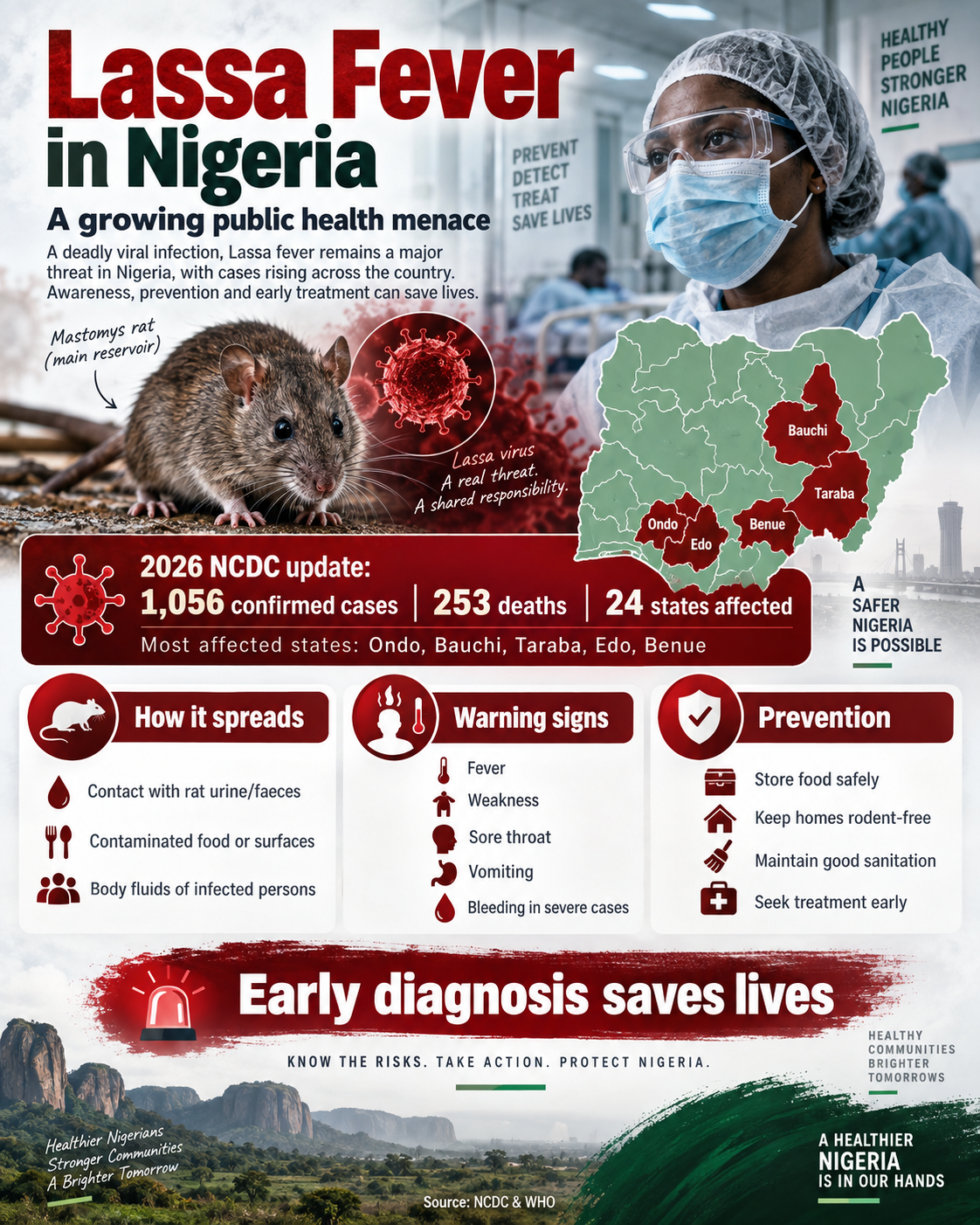
The latest Nigeria Centre for Disease Control and Prevention (NCDC) situation report for Epidemiological Week 34, covering August 17–23, 2026, shows why the disease remains a serious concern. Nigeria had recorded 7,580 suspected cases, 1,056 confirmed cases and 253 deaths from confirmed Lassa fever cases since the beginning of 2026. The case fatality rate stood at 24.0%, compared with 18.7% during the same period in 2025. Confirmed cases had been reported across 24 states and 118 Local Government Areas.
Perhaps even more concerning is the concentration of disease in several states. According to the NCDC, 87% of confirmed cases were reported from Ondo, Bauchi, Taraba, Edo and Benue states. Ondo alone accounted for 33% of confirmed cases, followed by Bauchi at 25%, Taraba at 13%, Edo at 10% and Benue at 6%.
What Is Lassa Fever?
Lassa fever is an acute viral illness caused by the Lassa virus. The disease was first identified in Nigeria in 1969 and remains endemic in Nigeria and several other West African countries.
The natural reservoir of the virus is primarily the Mastomys rodent, often called the multimammate rat. These rodents can carry the virus without appearing sick and can shed it through their urine and faeces.
Humans become infected mainly through contact with food, household items or surfaces contaminated with infected rodent urine or faeces. Infection can also occur through direct contact with infected rodents.
This makes poor food storage, open refuse, rodent infestation and inadequate environmental sanitation important contributors to the continuing transmission of Lassa fever.
Can Lassa Fever Spread From Person to Person?
Yes, although rodent-to-human transmission remains the main route.
Human-to-human transmission can occur through direct contact with the blood, urine, faeces or other bodily fluids of an infected person. Healthcare workers are particularly vulnerable when caring for suspected or confirmed patients without adequate personal protective equipment or proper infection-prevention procedures.
The WHO says there is no epidemiological evidence that Lassa fever spreads through the air between humans in the way respiratory viruses such as influenza do.
Healthcare Workers Are Also at Risk
Nigeria's 2026 outbreak has demonstrated the occupational risk faced by frontline healthcare workers.
By Epidemiological Week 34, the NCDC had recorded 54 healthcare workers affected by Lassa fever during 2026.
Earlier in March, the NCDC had already expressed concern over infections among healthcare personnel and called for stronger state-level action during the peak transmission season.
These infections reinforce the importance of routine infection-prevention practices in hospitals—not only after Lassa fever has been confirmed, but whenever health professionals encounter patients with unexplained fever.
Symptoms Can Look Like Malaria or Typhoid
One of the major challenges with Lassa fever is that its early symptoms can resemble other common illnesses.
The incubation period is usually 2 to 21 days.
Symptoms may begin gradually with:
- fever;
- weakness and general tiredness;
- headache;
- sore throat;
- muscle pain;
- chest pain;
- nausea and vomiting;
- diarrhoea;
- cough; and
- abdominal pain.
In severe cases, patients may develop facial swelling, bleeding, low blood pressure, shock, seizures, confusion or coma.
Because malaria, typhoid fever and several other infections can initially produce similar symptoms, laboratory testing is essential for diagnosis.
Most Infections Are Mild—but Severe Disease Can Be Deadly
The World Health Organization estimates that around 80% of Lassa virus infections are mild or asymptomatic, while roughly one in five infections can progress to severe disease affecting organs such as the liver, kidneys and spleen.
Among patients hospitalized with severe Lassa fever, mortality can be around 15% or higher. Nigeria's 2026 confirmed-case fatality rate of 24% underscores the seriousness of the current national burden.
Pregnant women, particularly during late pregnancy, can also face severe risks from Lassa fever. WHO reports very high maternal and fetal mortality in severe infections during the third trimester.
Another Serious Complication: Hearing Loss
Surviving Lassa fever does not always mean complete recovery without complications.
Sudden hearing loss has been reported among some people recovering from Lassa fever, and in some cases the hearing impairment may persist. Other reported complications include neurological problems, visual disturbances and prolonged recovery.
This is another reason Lassa fever should never be regarded as simply another fever.
Why Are Nigerians Still Dying?
The NCDC's Week 34 report identifies several continuing challenges, including late presentation to hospitals, high treatment costs, poor health-seeking behaviour, poor environmental sanitation, inadequate public awareness and infections among healthcare workers.
Late presentation is particularly dangerous.
A person may initially assume the fever is malaria, buy medicine from a pharmacy or self-medicate at home. By the time the illness fails to improve and the patient reaches an appropriate health facility, severe complications may already have developed.
This makes public awareness critically important.
In communities where Lassa fever is common, persistent fever that does not respond as expected to treatment should prompt medical evaluation.
How Nigerians Can Reduce the Risk
Preventing Lassa fever begins largely within homes and communities.
Food—including grains and other dry foods—should be stored in covered, rodent-resistant containers. Homes should be kept clean, refuse should be properly disposed of, and conditions that encourage rats to enter houses should be eliminated as much as possible.
Food exposed to possible rodent contamination should not be eaten. People should also avoid handling rodents with bare hands or consuming rats from environments where Lassa virus transmission may occur.
WHO emphasizes community hygiene and limiting rodents' access to food and homes as key preventive measures.
Healthcare facilities must also maintain strict hand hygiene, appropriate use of personal protective equipment, safe injection practices and precautions against exposure to patients' blood and body fluids.
Early Diagnosis Can Save Lives
There is currently no licensed vaccine against Lassa fever, although vaccine candidates are under development.
Supportive treatment—including careful fluid management and treatment of complications—can improve survival when started early. Ribavirin has historically been used against Lassa fever, but WHO notes that considerable uncertainty remains regarding its effectiveness and optimal use.
Anyone with suspicious symptoms, particularly after possible rodent exposure or contact with a confirmed Lassa fever patient, should seek medical attention promptly rather than relying solely on self-medication.
Lassa Fever Should Not Be a Seasonal Conversation
Every year, Nigerians hear warnings about Lassa fever when cases rise during the dry season. Then public attention gradually shifts elsewhere.
That cycle needs to change.
The NCDC itself recommends year-round community engagement, stronger state capacity for prevention and detection, timely treatment and strict infection-prevention practices among healthcare workers.
Nigeria's battle against Lassa fever cannot be won by hospitals alone.
It requires better sanitation, safer housing, proper food storage, waste management, rodent control, affordable access to healthcare, rapid laboratory diagnosis, protection of health workers and continuous public education.
A disease first identified in Nigeria more than half a century ago should not continue claiming hundreds of lives because people arrive at hospitals too late or because preventable exposure continues inside homes and communities.
The message is simple:
Keep rats away from food and living spaces. Store food properly. Maintain good sanitation. Do not ignore persistent fever. Seek medical attention early.
Lassa fever remains a menace—but many infections and deaths can be prevented when communities, healthcare workers and government act early.
References
- Nigeria Centre for Disease Control and Prevention. Lassa Fever Situation Report, Epidemiological Week 34, 17–23 August 2026.
- Nigeria Centre for Disease Control and Prevention. Disease Situation Reports: Lassa Fever, 2026.
- Nigeria Centre for Disease Control and Prevention. NCDC Calls for Strengthened State-Level Action as Lassa Fever Cases Rise During Peak Season, March 2026.
- World Health Organization. Lassa Fever Fact Sheet.
- World Health Organization. Lassa Fever – Nigeria: Disease Outbreak News.







Comments