
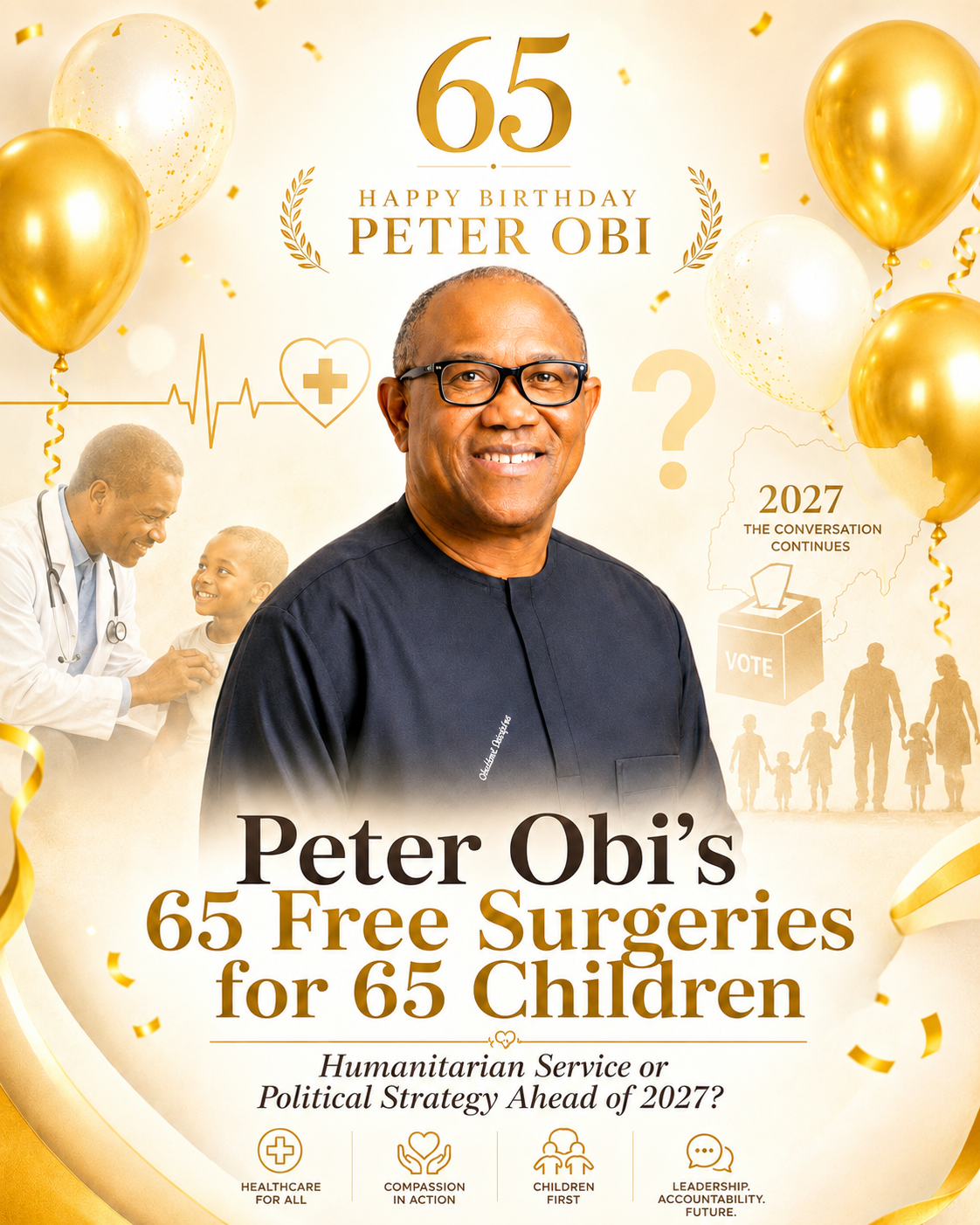
Peter Obi’s 65 Free Surgeries for 65 Children: Humanitarian Service or Political Strategy Ahead of 2027?
As Nigeria gradually moves toward the 2027 general election, virtually every action by a major political figure is likely to be viewed through two lenses: public service and political calculation.
That is exactly the debate surrounding Peter Obi’s decision to mark his 65th birthday by supporting 65 free surgeries for children at Mother Mary Hospital in Isolo, Lagos.
The former Anambra State governor and 2027 presidential candidate said the initiative was intended to celebrate his birthday through service rather than personal extravagance. Reports say the programme involved 65 children who underwent free surgical procedures, including adenotonsillectomy, under a medical team led by Dr. Folaseye Adebayo. Obi later attended the final follow-up clinic and appreciation programme at the hospital.
The question, however, is unavoidable:
Was this simply an act of humanitarian compassion—or also a political strategy designed to win public support ahead of 2027?
The fairest answer may be: it can be both.
The Humanitarian Case
Whatever one's political affiliation, 65 children receiving medical treatment without their families having to bear the full financial burden is a tangible benefit.
The procedures reportedly included adenotonsillectomy, which involves removing enlarged or chronically infected tonsils and adenoids that can contribute to breathing problems, recurrent infections and sleep-related difficulties in children.
For the affected parents, the most important issue is probably not political interpretation.
Their children received treatment.
Parents at the follow-up programme reportedly spoke about improvements in their children's health and quality of life.
That humanitarian impact should not be dismissed simply because the benefactor is a politician.
Obi himself said birthdays should be opportunities to give back and make a meaningful difference in other people's lives.
There is also evidence that the healthcare gesture was not his only birthday-related intervention. On his 65th birthday in July, Obi donated ₦10 million to St. Raphael's Hospital in Umueri, Anambra State, saying he preferred service to elaborate personal celebration.
Seen from this perspective, the surgeries fit into a broader public message about philanthropy and service.
But Politics Cannot Be Ignored
Peter Obi is not simply a private citizen giving to charity.
He is a major political figure seeking national office.
That changes how such gestures will inevitably be interpreted.
Healthcare is one of Nigeria's most emotionally powerful political issues. Families frequently struggle with the cost of consultations, medicines, diagnostic tests and surgeries.
A politician who directly pays for treatment therefore touches people at a very personal level.
And there is political value in that.
Images of a presidential candidate standing beside children who have received free medical treatment naturally communicate messages of:
compassion, accessibility, service, empathy and concern for ordinary Nigerians.
No sophisticated political advertisement may communicate those qualities as effectively as photographs of grateful parents and recovering children.
That does not automatically make the gesture cynical.
Political leaders can genuinely care about people while also understanding that good deeds enhance their public image.
Humanitarianism and Political Capital Can Coexist
Perhaps the mistake is assuming we must choose only one explanation.
Politics and humanitarian service are not mutually exclusive.
A politician may genuinely want to help people and still recognize that public service strengthens political credibility.
The more useful question is therefore not:
“Did Peter Obi gain political advantage from helping these children?”
He almost certainly gains some positive public perception from such an initiative.
The more important questions are:
Were the children genuinely helped?
Was the intervention transparent?
Was the assistance delivered regardless of political affiliation?
Has the politician demonstrated similar concern outside election periods?
And does his political programme propose sustainable solutions for millions of Nigerians who cannot depend on individual acts of charity?
Those questions take us beyond personality politics.
Charity Cannot Replace a Health System
There is another important side to the story.
Sixty-five successful surgeries deserve celebration.
But Nigeria has millions of children.
No politician—Peter Obi or anyone else—can personally finance healthcare for everyone who needs it.
This is where humanitarian gestures must eventually become public policy.
A functioning healthcare system should not require poor families to wait for a wealthy politician, celebrity, religious organization or philanthropist before their children can receive necessary surgery.
Nigeria needs healthcare systems in which ordinary families can access treatment without being pushed into poverty.
That means strengthening:
- primary healthcare;
- public hospitals;
- health insurance;
- maternal and child healthcare;
- medical workforce retention;
- affordable medicines;
- surgical capacity; and
- accountability in healthcare spending.
Political leaders should therefore be judged not only by the people they personally assist, but by whether their policies can make healthcare accessible to millions.
The Timing Will Raise Questions
With the 2027 election approaching, critics are entitled to question the political significance of highly visible charitable interventions by presidential candidates.
That scrutiny is healthy in a democracy.
But criticism should also be fair.
If politicians spend money only on rallies, billboards, motorcades and political patronage, citizens complain—and rightly so.
If a politician instead directs resources toward children's healthcare, the beneficiaries should not be deprived of recognition simply because an election is approaching.
The question should be whether the generosity reflects a consistent philosophy of leadership or merely an election-season performance.
That distinction can only be assessed over time.
Nigerians Should Demand More From Every Candidate
The discussion should not become simply another Peter Obi versus anti-Peter Obi argument.
Every serious presidential candidate should be challenged on healthcare.
What will they do about Nigeria's healthcare workforce?
How will they reduce out-of-pocket medical spending?
How will they improve rural hospitals?
How will they protect children whose parents cannot afford surgery?
How will they strengthen health insurance?
And what measurable health outcomes should Nigerians expect after four years in office?
Those questions matter far more than political slogans.
BabaCares Perspective
Helping 65 children obtain needed medical treatment is, on its face, a humanitarian act.
The fact that Peter Obi is also a presidential candidate means the gesture inevitably carries political symbolism and may strengthen his image among voters.
Both things can be true simultaneously.
But the children should remain at the centre of the story.
If 65 families now have healthier children because someone chose to spend resources on medical care rather than personal celebration, that outcome deserves recognition.
At the same time, Nigerians should continue asking a larger question:
Can our political leaders build a country where a child does not need the birthday generosity of a politician before receiving essential healthcare?
That is the standard against which humanitarian gestures should ultimately be measured.
A good deed can touch 65 lives. Good public policy can touch millions.
BabaCares — promoting informed conversations about health, healthy ageing and wellbeing.
References
- The Guardian Nigeria. “Obi Marks 65th Birthday With Free Surgeries for 65 Children.” September 3, 2026.
- TVC News. “Peter Obi Marks 65th Birthday With 65 Free Surgeries for Children.” September 3, 2026.
- Peter Obi public statement on the completion of 65 free surgeries at Mother Mary Hospital, Isolo.
- Punch Newspapers. “Obi Donates N10m to Anambra Hospital on 65th Birthday.” July 19, 2026.
- Premium Times. “At 65, Peter Obi Reflects on Service, Donates N10m to Rural Hospital.” July 20, 2026.







Comments